In spite of the rich selection of elements available in Mule, you may find yourself in need to put together some custom code to carry out part of a complex task, if you’re comfortable coding in Ruby, then the Ruby Component is the ideal versatile tool to fall back on for these cases.
Mule also includes also equivalent scripting components for other languages. The Ruby Component is also handy for when you’re modernizing legacy systems, as you can simply throw the old lines of code into a component instead of having to reengineer the code’s behavior through a series of different Mule components (this is not ideal from a debugging and maintenance perspective, though).
The Python script is generally executed at runtime (client-side request) and the custom logic embedded in the script could trigger an application to execute a database transaction, or modify your web-page interface.
Python also allows the developer to configure interceptors and alter the values or references of particular properties in a script. Interceptors are configured to provide additional services to a message as it flows through a component.
For example, a developer can configure an interceptor to execute scheduling or logging of a particular event while a message is being processed.
The Python component also includes a custom interceptor which allows you to configure settings for Spring elements. Use the Advanced tab to access Script Properties, then define the value and reference for a particular property in the script.
When using Python, typing-in or appending a script to the component is the only configuration required. For more details Mulesoft Online training
Configuration:
General Tab
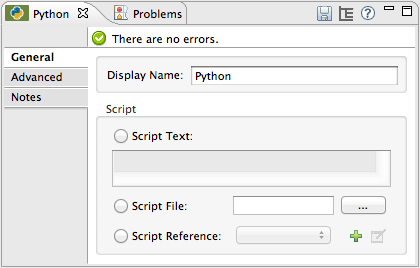
To configure the Python component, from the Message Flow canvas double-click the Python icon to open the Properties Editor. Use the General tab to specify the file location of the script or simply type in the script on the script text window. The scripting engine is Python.
Advanced Tab
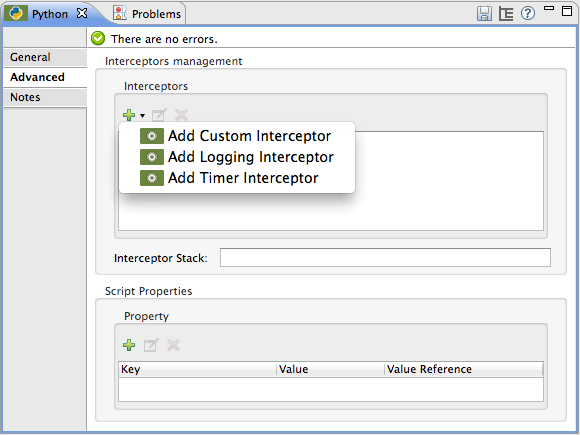
Use the Advanced tab to optionally configure interceptors and, depending on the interceptor, enter Spring values.You also have the option to specify script properties, which are key/value pairs used to alter or change properties in the script.
Interceptors
Interceptors alter the values or references of particular properties in a script. They are configured to provide additional services to a message as it flows through a component. For example, you can configure an interceptor to execute scheduling or logging of a particular event while a message is being processed.
The Script component also includes a custom interceptor which allows you to configure settings for Spring elements.
For example, you can add an interceptor that logs transactions and the time for each transaction. Use the Add Custom Interceptor to create a custom interceptor that can reference Spring objects. Learn more skills from Mule Training
The Interceptor Stack enables you to bundle multiple interceptors. Use the Interceptor Stack to apply multiple interceptors on a Python component. The interceptors are applied in the order defined in the stack.
Script Properties
Configure these parameters to define the attribute keys and their associated values. This enables the script component to quickly look up a value associated with a key.
Adding External Libraries
In Mule, Python is used through Jython. This library requires to set the environment variable python.path to correctly find the external libraries.
When deploying to a customer managed Mule runtime (one that’s deployed on-premises), then you can set the python.path property directly in the wrapper.conf file. See system properties for a better understanding of how to set it.
When deploying to a MuleSoft managed Mule runtime (deployed to CloudHub), then you must add an application property to your deployed application. Name this property python.path and set it to /opt/mule/mule-CURRENT/apps/<APPNAME>/classes.
Examples:
<http:listener-config name="http_conf" host="localhost" port="8081" doc:name="HTTP Response Configuration"/>
<flow name="greedy">
    <http:listener path="/" doc:name="HTTP Connector" config-ref-inbound="http_conf"/>
    <http:body-to-parameter-map-transformer />

    <set-payload value="#[payload['amount']]" />
    <transformer ref="StringToNumber" />
    <transformer ref="DollarsToCents"/>


    <scripting:component doc:name="GBP Currency Script">
        <scripting:script file="greedy.py">
            <property key="currency" value="GBP"/>
        </scripting:script>
    </scripting:component>

</flow>
Below are the contents of the python file that implements the algorithm:
# Adapted from "Python Algorithms: Greedy Coin Changer" by Noah Gift
# http://www.oreillynet.com/onlamp/blog/2008/04/python_greedy_coin_changer_alg.html

import sys

class Change:
    def __init__(self, currency, amount):
        self.amount = amount
        if currency == "USD":
            self.coins = [1,5,10,25]
            self.coin_lookup = {25: "quarters", 10: "dimes", 5: "nickels", 1: "pennies"}
        elif currency == "GBP":
            self.coins = [1,2,5,10,20,50,100,200]
            self.coin_lookup = {200: "two_pounds", 100: "pounds", 50: "fifty_pence", 20: "twenty_pence", 10: "ten_pence", 5: "five_pence", 2: "two_pence", 1: "pennies"}
        #else:
        #   print "Currency $currency not recognized"
        #   exit 1
        self.result = ""

    def printer(self,num,coin):
        if num:
            if coin in self.coin_lookup:
                if self.result == "":
                    self.result = '%1.0f %s' % (num, self.coin_lookup[coin])
                else:
                    self.result = '%s, %1.0f %s' % (self.result, num, self.coin_lookup[coin])

    def recursive_change(self, rem):
        if len(self.coins) == 0:
            return []
        coin = self.coins.pop()
        num, new_rem = divmod(rem, coin)
        self.printer(num,coin)
        return self.recursive_change(new_rem) + [num]

c = Change(currency, payload)
c.recursive_change(c.amount)
result = "[" + c.result + "]"
For more in-depth knowledge, enroll for a live free demo on Mulesoft Training
 Mulesoft Online Learning