Getting started with the Automated Test Framework

If you are new to the Automated Test Framework, read this overview to learn what the framework can do. Next, follow the tutorial to create and run a test that uses the most basic of ATF features. After you feel comfortable with the basics, explore more advanced features provided by the ATF.

ATF features provide flexibility in how you test your instance.

Test step configuration categories

Service Catalog in Service Portal:

Perform end-to-end testing for a catalog item in the Service Portal.

  • Open a record producer, catalog item, or order guide.
  • Set variable values and catalog item quantity.
  • Validate variable values, states, price, and items included in an order guide.
  • Navigate in an order guide.
  • Open and toggle catalog items in an order guide.
  • Add an item or an order guide to a shopping cart.
  • Order a catalog item or an order guide.
  • Submit a record producer. more on Servicenow Training

Application Navigator:

Create tests to check navigation features.

  • Verify that application menus are listed in the left navigation bar.
  • Verify that application modules are listed in the left navigation bar.
  • Navigate to a module as if a user clicked the module in the left navigation bar.

Custom UI:

Create simple tests that mimic user actions with no scripting.

  • Set component values.
  • Assert that specified text is or is not on a page.
  • Validate component values.
  • Click components.
  • Validate the states of components (read-only or not read-only).

Form:

Create tests of forms.

  • Open a new form or an existing record.
  • Set field values.
  • Validate field values or field states (such as mandatory, not mandatory, read only, not read only, visible, and not visible).
  • Validate whether a UI action is visible.
  • Click a button on a modal page.
  • Click a UI action.
  • Submit a form.

Service Catalog:

Perform end-to-end testing for a catalog item.

  • Open a catalog item or a record producer.
  • Search for a catalog item.
  • Set variable values and catalog item quantity.
  • Validate variable values, states, and price.
  • Add an item to a shopping cart.
  • Order a catalog item.
  • Submit a record producer.

REST:

Create and send an Inbound REST request and verify the response.

  • Test any REST endpoint on the instance.
  • Use a REST request to create records, as well as retrieve, update, or delete records created in a previous test step or that already existed on the instance.
  • Verify the response status code, response headers, response time, and response payload.

For more in-depth knowledge, enroll for live free demo on Servicenow Online Training

Java vs kotlin Difference between the two

Java:

Java is a general-purpose programming language that is class-based, object-oriented, and designed to have as few implementation dependencies as possible. It is intended to let application developers write once, run anywhere (WORA), meaning that compiled Java code can run on all platforms that support Java without the need for recompilation

Kotlin:

Kotlin is a cross-platform, statically typed, general-purpose programming language with type inference. Kotlin is designed to interoperate fully with Java, and the JVM version of its standard library depends on the Java Class Library, but type inference allows its syntax to be more concise.

Kotlin vs Java

  • Java compilation time is 15-20% faster than Kotlin compilation time but in perspective of incremental build compilation, Kotlin will also take same compilation time as Java Online Training.
  • In Kotlin, we can’t assign null values to variables or return values, if we really want to assign then we can declare a variable with special syntax whereas in Java we can assign null values but when we try to access objects pointing to null values raises an exception.

Code Conciseness

  • Comparing a Java class with an equivalent Kotlin class demonstrates the conciseness of Kotlin code. For performing the same operation that the Java class does, a Kotlin class necessitates for less code.
  • For example, a particular segment where Kotlin can significantly reduce the total amount of boilerplate code is findViewByIds.
  • Kotlin Android Extensions permit importing a reference to a View into the Activity file. This allows for working with that View as if it was part of the Activity.

Coroutines

  • CPU-intensive work and network I/O are long-running operations. The calling thread is blocked until the whole operation completes. As Android is single-threaded by default, an app’s UI gets completely frozen as soon as the main thread is blocked.
  • The traditional solution for the problem in Java is to create a background thread for the long-running or intensive work. However, managing multiple threads leads to an increase in the complexity as well as errors in the code.
  • Kotlin also allows the creation of additional threads. However, there is a better way of managing intensive operations in Kotlin, known as coroutines. Coroutines are stackless, which means they demand lower memory usage as compared to threads.
  • Coroutines are able to perform long-running and intensive tasks by suspending execution without blocking the thread and then resuming the execution at some later time. It allows the creation of non-blocking asynchronous code that appears to be synchronous.
  • The code using coroutines is not only clear but concise too. Moreover, coroutines allow for creating elegant additional styles of asynchronous non-block programming such as async/await.

For more in-depth knowledge, enroll for live free demo on Java online Course

Extension Functions

Kotlin allows developers to extend a class with new functionality via extension functions. These functions, although available in other programming languages like C#, aren’t available in Java.

Creating an extension function is easy in Kotlin. It is done by prefixing the name of the class that needs to be extended to the name of the function being created. In order to call the function on the instances of the extended class, one needs to use the ‘.’ notation.

MuleSoft: What is API and API Management

What is an API?

API is the acronym for Application Programming Interface, which is a software intermediary that allows two applications to talk to each other. Each time you use an app like Facebook, send an instant message, or check the weather on your phone, you’re using an API.

What Is an Example of an API?

When you use an application on your mobile phone, the application connects to the Internet and sends data to a server. The server then retrieves that data, interprets it, performs the necessary actions and sends it back to your phone.

The application then interprets that data and presents you with the information you wanted in a readable way. This is what an API is – all of this happens via API. More Mulesoft Online Training

To explain this better, let us take a familiar example.

Imagine you’re sitting at a table in a restaurant with a menu of choices to order from. The kitchen is the part of the “system” that will prepare your order. What is missing is the critical link to communicate your order to the kitchen and deliver your food back to your table. That’s where the waiter or API comes in. The waiter is the messenger – or API – that takes your request or order and tells the kitchen – the system – what to do. Then the waiter delivers the response back to you; in this case, it is the food.

What is API management?

API management is the process of designing, publishing, documenting and analyzing APIs in a secure environment. Through an API management solution, an organization can guarantee that both the public and internal APIs they create are consumable and secure. More skills from Mulesoft Training

API management solutions in the market can offer a variety of features; however, the majority of API management solutions allow users to perform the following tasks:

  • API design – API management solutions provide users – from developers to partners – the ability to design, publish and deploy APIs as well as record documentation, security policies, descriptions, usage limits, runtime capabilities and other relevant information. 
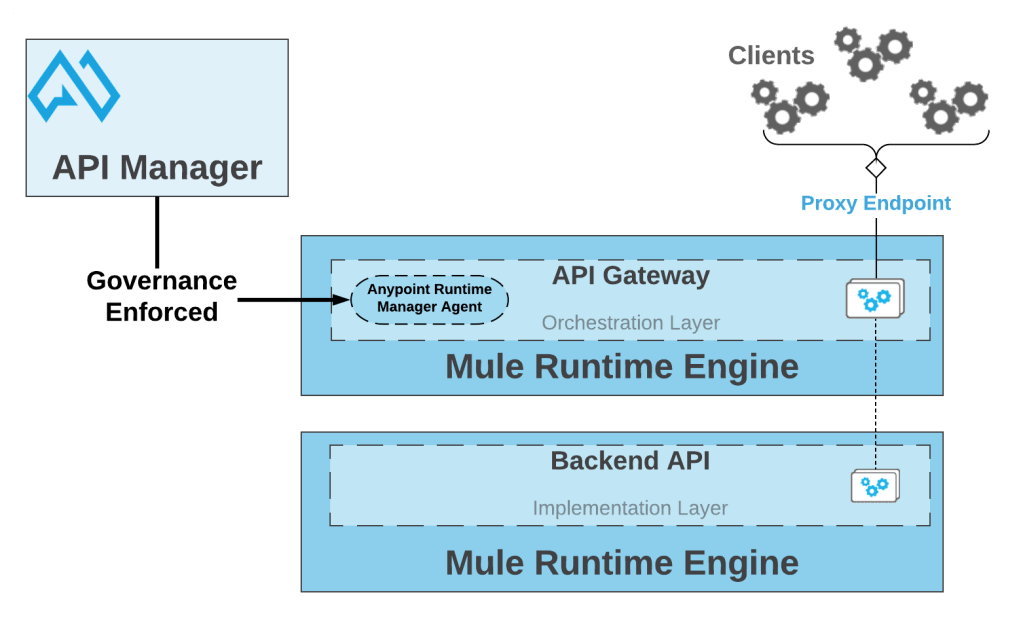
  • API gateway – API management solutions also serve as an API gateway, which acts as a gatekeeper for all APIs by enforcing relevant API security policies and requests and also guarantees authorization and security. 
  • API store – API management solutions provide users with the ability to keep their APIs in a store or catalog where they can expose them to internal and/or external stakeholders. This API “store” then serves as a marketplace for APIs, where users can subscribe to APIs, obtain support from users and the community and so on. 
  • API analytics – API management allow users to monitor API usage, load, transaction logs, historical data and other metrics that better inform the status as well as the success of the APIs available.  Get More skills from Mule Training

Ensure every API is secure and governed

With just a few simple steps, secure APIs with policies, manage client access, group APIs as products, and monitor and analyze traffic. No matter where your APIs and microservices are hosted and which technologies they run on, you can manage them all from one place.

  • Unlock applications, data, and microservices with an API gateway
  • Apply prebuilt or custom security policies at runtime with no downtime
  • Proxy existing SOAP services or create new APIs from OAS and RAML definitions
  • Provision access across individual clients or entire teams with OAuth and SAML
  • Use a service mesh to secure and govern microservices — regardless of where they’re hosted
  • Gain insight into the performance of APIs, track usage, and identify errors

For more in-depth knowledge, enroll for live free demo on MuleSoft Certification

Top ways that How IBM Cognos is changing the Business

IBM Cognos Analytics may be a self-administration Analytics platform, that mixespsychological feature computing Technology, together with AI and cubic centimeter, at first created for Watson Analytics. as an example, the stage utilizes psychological feature Technologies to assist computerize info Processes.

The software package learns clients’ infoand mayproduce proposals for Visualizations and information Joins. It’s like associatebeat one Platform, thereforeprovides Analytics capacities running from planning dashboards, and information coordination to Report information Modelling. Get more skills from Cognos Training

Here are  the ways that companies use to transform their Business

Expanding Charity Donations with Only Text Analytics

Like abundantpedagogyestablishments Michigan State University (MSU) tries to lift donations, from graduated categories and completely different partners. nonetheless wouldn’t wish tocombine potential donors, with fun-raising Suggestions, that may harsh them on giving.

To take care of this issue, MSU’s University Advancement Team is utilizing content examination, to order graduated category and partner records to create its raising cash demands, progressively powerful.

MSU is utilizing IBM Cognos Analytics, to orderinformation from Bio information, records of the council and govtconferences reports, from volunteering activities, graduates and workers records, and Donation transactions.

It additionally obtaining information from blogs, internet journals, and on-line networking content and has bought furtherinformation indexes from suppliers, as an example, noesis Nexis.

Analyzing Retail Operations with Purchase set of Analytics

With its Extra-ordinary Hotels, spa the stone Beach resort in Monterey, Calif., includes a full-administration retail activity with fifteen stores. The Resort had tiny visibility into the stock levels, of its retail activity and increase with round-faced stockouts.

This ends up insad guests, to extendhigher visibility into its retail activity and optimizing Purchases, the resort visited IBM Cognos Analytics to cope with the influx and outflow of regardingthirty,000 things over its stores.

Pebble Beach centralized with previous siloed info from its distinctive retail schemes, and altered from on-premises servers to the cloud, providing it with higher access to retail info. The building has cut the expense of offers by virtuallytwo%, and fasten news from hours to Minutes.

Utilizing the Information to Boost fan Engagements

Every year, the All European countrytennis Club (AELTC) carries several viewers to the grounds and a largerange of viewers, from round the globe to the Wimbledon Championships.

Like different major games, it’sperpetually tested with finding higherways that, to interact in fans and hold Viewers.

Media sources that collaborate with AELTC to holdWimbledon, to the globe are whenever on the hunt to hide the matches, in associate all the a lot of convincing approach to develop their viewers. Learn more from Cognos Online Training

Sending Information science to keep Populations healthy

Norway is that the world’s biggest manufacturer, of Atlantic salmon and has exports of ninety five% of its Production. ocean lice are among the best threats to Norway’s wild salmon population, and its salmon cultivating business.

The parasite naturally happens in marine waters, however, it’s received by artificial means high concentrations, in several of Norway’s and beach Coast waters thanks to serious Production of salmon and rainbow.

The food Innovation Cluster, associate industry-financed Company, has created the wealth and health of Norway’s salmon a crucialissue. It says that ocean lice the board pricesthe corporatea minimum of $600 million per annum

Design a site like this with WordPress.com
Get started